
Blog
His Eminence Lama Thubten Rigsel Rinpoche’s visit to Singapore
Introduction
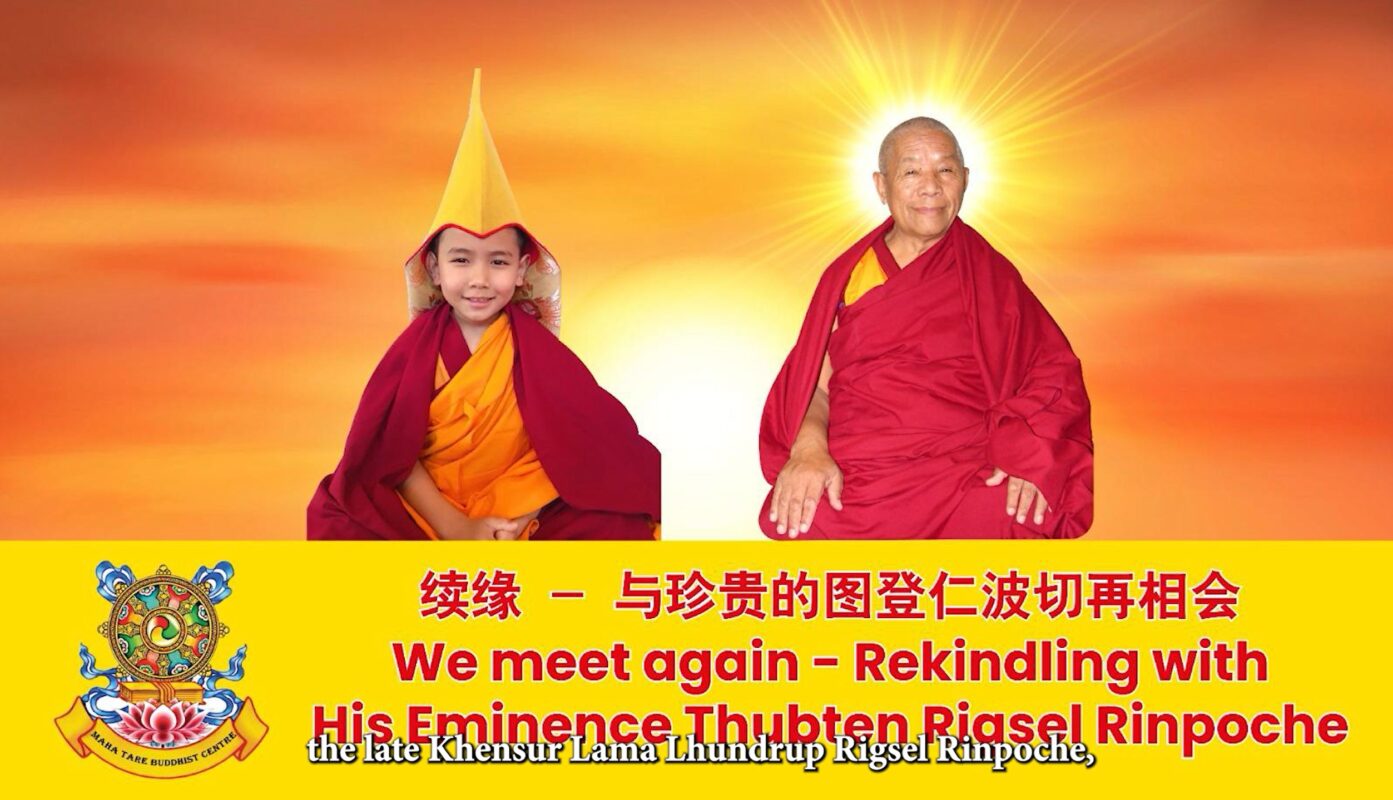
Today, we welcome and celebrate His Eminence Lama Thubten Rigsel Rinpoche’s visit to Singapore. It is his first visit since his previous incarnation, the late Khensur Lama Lhundrup Rigsel Rinpoche, last visited Singapore in 2011. Yangsi Rinpoche reunites with us today, returning to turn the wheel of the Dharma once again.
Rinpoche is dear to the hearts of all Dharma friends of the Maha Tare Buddhist Centre, not least because of Rinpoche’s special connection to our resident teacher, Geshe Lama Konchok.
Like many who passed through the hallowed halls of Kopan Monastery where Khensur Rinpoche was its first abbot, Geshe Konchok was the beneficiary of Rinpoche’s infinite kindness and patience. The great deeds and attainments of Rinpoche span decades of his dedicated service to the Dharma, and in particular to Kopan Monastery.
It is in Rinpoche’s honour that tonight’s event is held, and we are privileged to be able to host Rinpoche this evening.
About Khensur Lama Lhundrup Rigsel Rinpoche
Whilst it is wonderful to see Yangsi Rinpoche here today, no homage is complete without understanding the life of Yangsi Rinpoche’s former incarnation, Khensur Lama Thubten Rigsel Rinpoche.
The late Khensur Rinpoche was born in Tibet in 1941 to a poor peasant family.
He joined Sera Monastery in Lhasa as a boy and went to India in 1959, where he came to know the great masters Lama Yeshe and Lama Zopa Rinpoche.
In 1972, a few years after Kopan Monastery was founded, Khensur Rinpoche was invited by Lama Yeshe to Kopan Monastery to teach young monks there, who were being educated in the Gelugpa tradition.
He was acting abbot from 1984 to 2001, when he was officially appointed abbot and he remained in that position up until two months before he passed away in September 2011.
It was under Khensur Rinpoche’s stewardship that Kopan Monastery came to become an institute of learning rivalling those of the 3 great Gelugpa monasteries of Sera, Drepung and Ganden.
Khensur Rinpoche played a significant role in establishing Kopan as a centre for the study and practice of Tibetan Buddhism, particularly for international students from the West.
He was instrumental in developing the teachings of Lama Tsongkhapa within the monastery and throughout Nepal.
Khensur Rinpoche was known for his unconditional kindness to all the students of Kopan, especially the young monks. He was always looking out for their well-being and welfare. Till today, many former students of Khensur Rinpoche remember him that way.
Khensur Rinpoche & Kopan Monastery
A great part of Khensur Rinpoche’s life is inseparable from the great religious institution of Kopan.
Kopan Monastery, nestled in the Kathmandu Valley of Nepal, boasts a rich history deeply intertwined with the lives of its founders and the early challenges they faced.
Established in 1969, its story begins with Lamas Thubten Yeshe and Thubten Zopa Rinpoche. After fleeing Tibet in 1959, they met in the Buxa Duar refugee camp in India and eventually arrived in Nepal in 1968, together with Khensur Rinpoche.
Initially residing near Boudhanath Stupa, they later acquired an old house and land atop Kopan Hill, previously owned by the King of Nepal’s astrologer.
The first temple was constructed between 1971 and 1972, largely funded by the growing number of Western disciples drawn to their teachings. The vision of Lamas Yeshe and Lama Zopa Rinpoche whose works Khensur Rinpoche saw to it, were done with aplomb. Their vision was to create a monastery for young Himalayan monks and nuns, and a center for Westerners to study and practice Tibetan Buddhism. The first monks, primarily young boys from the Solu Khumbu and Manang regions of Nepal, joined soon after the land was acquired. Many were sent by Lama Zopa Rinpoche, who was simultaneously re-establishing the Lawudo retreat center.
Simultaneously, the Lamas began teaching Dharma to Western students who had heard of their reputation. Regular weekly classes commenced, culminating in the first month-long meditation course in the spring of 1971. This course, initially attended by only twenty-five students, quickly grew in popularity. By 1973, two hundred students were participating in the twice-yearly courses, enduring remarkably austere conditions. Sleeping on straw mats, relying on a local spring for water, and having food carried up the hill by porters were commonplace.
Despite these hardships, the monastery’s appeal continued to grow. Westerners, disillusioned with materialism and seeking spiritual meaning, flocked to Kopan to learn from the Lamas. Many took ordination vows and formed a small Western sangha community under Lama Yeshe’s guidance, until a change in Nepal’s visa regulations in 1985 forced many to leave. The early years of Kopan Monastery were a testament to the dedication and perseverance of its founders as well as Khensur Rinpoche’s tireless work and early students, laying the foundation for the thriving institution it is today.
The great works of Khensur Rinpoche can be seen today not only in the form of the growing enrolment of the ordained as well as lay students at Kopan, but also in the hearts of the many students have had the good fortune of coming under Khensur Rinpoche’s care.
Many such students are eminent Geshes and teachers the world over, a phenomenon made possible by the blessings of the Triple Gem and in particular, those of Khensur Rinpoche himself.
Illness and Passing
Khensur Rinpoche worked tirelessly for the Dharma and all those under his charge.
Although he was diagnosed with advanced stomach cancer in January 2011 and stepped down as abbot in July 2011, he worked tirelessly throughout his life and his tenure at Kopan. Even in illness, he continued teaching and encouraging his followers and students.
Khensur Rinpoche passed into parinirvana on September 7, 2011, at 11:10 PM, and entered clear light meditation.
Reincarnation
In our Buddhist beliefs, the concept of impermanence should be viewed not as a reason for despair, but a reason for hope. The purity of Khensur Rinpoche’s motivations to benefit all sentient beings, meant that Khensur Rinpoche would return to turn the wheel of the Dharma again.
Following his passing, the late Lama Zopa Rinpoche initiated the search for Khensur Rinpoche’s reincarnation.
Yangsi Lama Tenzin Rigsel Rinpoche was born on January 29, 2013 and was identified and subsequently officially recognized as the reincarnation by His Holiness the 14th Dalai Lama on May 3, 2016.
The event symbolizes the reestablishment of karmic connections between guru and disciple, offering opportunities for both past students and new followers to connect with Rinpoche in this life, which is one which we immensely treasure.
The Dharma friends of the Maha Tare Buddhist Centre wish Yangsi Rinpoche a long, stable and healthy life, and may we have the good fortune to meet him again, again and again!
We rejoice in Yangsi Rinpoche’s presence with us this evening, and may all enjoy auspicious conditions!